
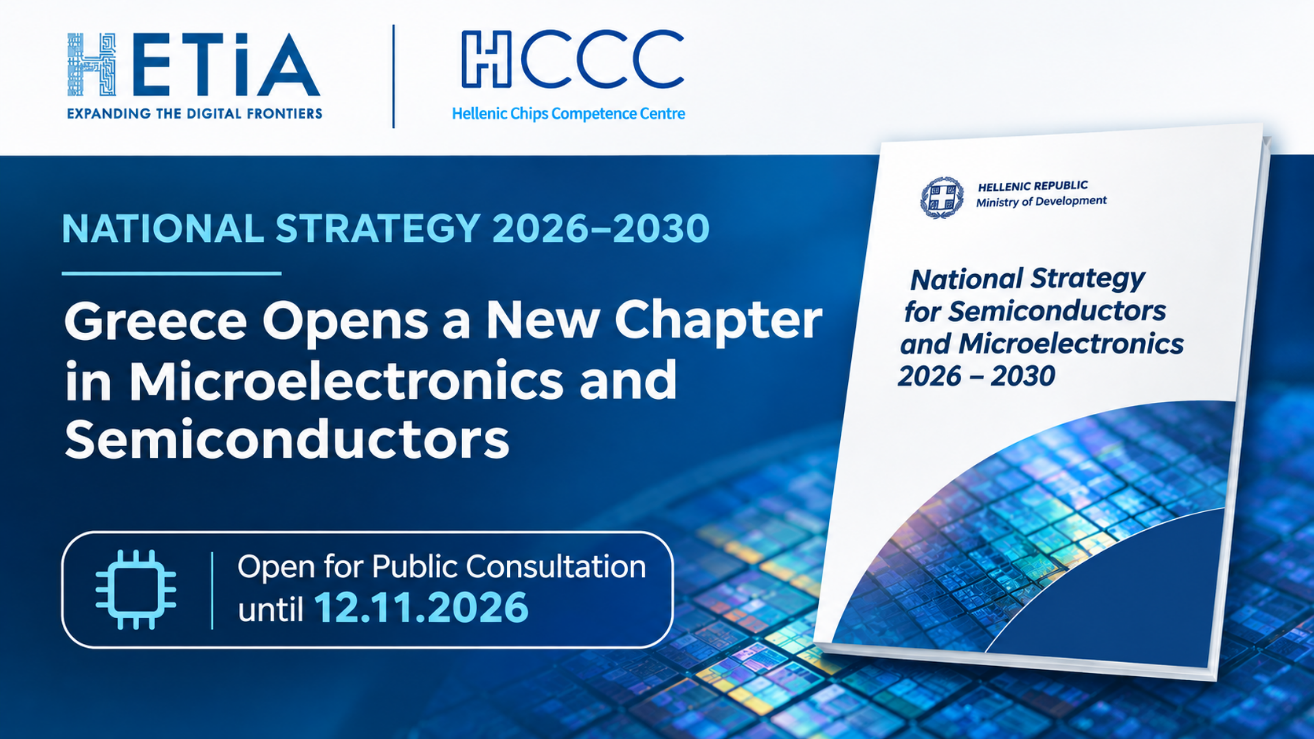
National Semiconductor and Microelectronics Strategy 2026–2030 Open for Public Consultation
A significant development marking the culmination of more than two years of sustained efforts by HETiA, further strengthened through its coordinating role in the Hellenic Chips Competence Centre (HCCC).
On 29 October 2026, the Greek Ministry of Development announced the launch of the public consultation on the draft National Strategy for Semiconductors and Microelectronics 2026–2030, marking a decisive step towards establishing a coherent national policy in a sector of strategic importance for the Greek economy, industrial competitiveness and European technological autonomy.
This development represents a significant milestone in an initiative launched more than two years ago by the Hellenic Emerging Technologies Industry Association (HETiA), aimed at highlighting the capabilities of Greece’s microelectronics sector, documenting industry needs and promoting the development of a National Strategy. These efforts were further strengthened through the establishment of the Hellenic Chips Competence Centre (HCCC), coordinated by HETiA as Project Coordinator.
Through HCCC, which brings together 16 partners from academia, research and industry, HETiA coordinates a collective effort to strengthen Greece’s capabilities in semiconductors, foster closer links between research and industry, and capitalize on the opportunities offered by the European Chips Act.
The Five Strategic Priorities
- Chip Design, IP and HCCC: Strengthening chip design capabilities and facilitating access to EDA tools, pilot lines and European technology infrastructures.
- Research, Innovation and Technological Specialization: Connecting research with industry, supporting prototyping and facilitating technology transfer.
- Skills and Human Capital: Developing specialized training programmes and strengthening the sector’s talent pool.
- Demand and Strategic Applications: Promoting microelectronics applications in defence, energy, maritime, healthcare and industry.
- Investments and Infrastructure: Attracting investment and developing advanced technological infrastructure.
The Role of HETiA and HCCC
Τ The draft Strategy recognizes HCCC as a key technical hub within Greece’s semiconductor ecosystem, facilitating access to design tools, prototyping capabilities, European pilot lines, skills development and business support services.
At the same time, it highlights HETiA’s role in industry representation, ecosystem mapping, identifying industrial needs, and connecting businesses, research organizations and European institutions.
The Ministry of Development’s official announcement also makes specific reference to the €3.63 million in funding allocated to the Hellenic Chips Competence Centre.
From Strategic Recognition to Implementation
For HETiA and HCCC, the publication of the draft Strategy represents both recognition of sustained efforts over several years and the beginning of a new phase focused on translating strategic priorities into concrete actions, mobilizing funding instruments, building partnerships and delivering measurable results for Greek industry and research.
The public consultation will remain open until Thursday, 12 November 2026. HETiA and HCCC encourage businesses, universities, research centres and industry stakeholders to actively participate by submitting comments and proposals that will contribute to shaping a realistic and actionable National Strategy.
An initiative launched more than two years ago is now taking shape as a concrete national strategic direction. The next step is to translate this vision into tangible results for Greece’s microelectronics sector.
National Strategy 2026–2030 | Public Consultation
Consultation deadline: 12 November 2026.
The full draft National Strategy and information on how to participate in the public consultation are available through the official announcement of the Greek Ministry of Development.
National Strategy 2026–2030 – Official Announcement and Public Consultation Information


HCCC project is supported by Chips JU and its members, and is co-funded by European Union and the Greek Government via the “Competitiveness” Programme.
Co-funded by the European Union. Views and opinions expressed are however those of the author(s) only and do not necessarily reflect those of the European Union or EYDE-VEK. Neither the European Union nor the granting authority can be held responsible for them.